Is the tech job market recovering or still collapsing? I built an AI-driven indicator to track the truth.


What’s the actual situation with tech hiring?
There are many ways to find the answer to this question.
Subjective methods—keeping an eye on what’s happening at your own company, getting updates from acquaintances at other tech companies, or following news about layoffs.
Objective methods—analyzing macroeconomic indicators or examining statistics on the number of job openings on job boards.
People usually focus on this last indicator—the number of currently open job positions. But this is a relative metric (is 1,000 open positions for a specific tech role a lot or a little?), which fails to account for the fact that the number of both tech companies and job seekers continues to grow even during a crisis (which is why 1,000 open positions were a good sign a year ago, but are a bad sign now).
A year ago, we created a more accurate indicator of hiring activity.
Every day, AI agents directly scan thousands of sources: company websites, ATS, and job boards. Millions of accumulated records on the opening and closing dates of job postings for each tech role at each of thousands of companies allow us to see trends in the growth or decline of hiring for specific tech roles.
What’s the problem with the traditional “number of active job postings”?
The number of open tech positions may continue to rise even during the crisis
Reason #1
When there are mass layoffs, some employees don’t go looking for a job—they pivot to entrepreneurship instead.
After all, a crisis often drastically changes people’s behavior.
In 2008, everyone wanted to save money and earn extra income—which is why platforms like Airbnb and Uber took off.
In 2020, the pandemic kept everyone at home—leading to the rise of delivery services, online education, and remote work.
During a crisis, startups address a new, pressing market need.
Therefore, the job vacancy statistics might look like this:
- 1,000 tech companies have completely halted hiring and carried out significant layoffs—the number of open positions at these companies is now zero.
- But in each of these 1,000 companies, there was at least one laid-off employee who tells themselves, “It’s pointless to look for a job in the current market anyway; now is finally the time to do what I’ve long dreamed of.” Pooling their savings, they launch a tech startup—formulating an idea, preparing a business plan, and launching development. And they post at least one job opening.
If we look at the number of open job positions, the total number of open positions on the market has not decreased (and may, in fact, have increased).
But this is an unequal exchange:
When a medium- or large-sized tech company freezes hiring, it actually removes a multiplier effect of job openings from the market—after all, a single job opening for a specific role at a large company may represent hundreds of hired professionals.
At a tech giant, a single job opening often means mass hiring (they’re looking for dozens of people for a single role). Whereas at a startup, a single job opening usually equals one person.
Reason #2
And this is yet another reason why startups are posting low-volume job openings. The tech market is not isolated from the economy and is declining alongside dozens of other sectors. And in these other sectors, the situation may be much worse, which could lead to a shift of entrepreneurs and businesses toward the tech market—where less investment is often required and there are more opportunities to operate independently of any specific country.
But the problem isn’t just the number of job openings. The problem is the competition for those positions.
Which is better—1,000 open positions or 1,100?
It might seem like a weird question—the more job openings there are, the better, right?
OK, let’s clarify the question a little:
Which is better:
– 1,000 open positions at 10,000 tech companies
– 1,100 open positions at 12,000 tech companies
It seems like the second one. But actually, it’s the first.
In absolute terms, the number of open positions can grow even during layoffs for another reason: the number of tech companies is constantly increasing. The number of tech professionals is also constantly growing—as is the competition among them.
There were 1,000 open positions at 10,000 tech companies, with 10,000 tech professionals applying for them.
In total, there were 10 applicants per job opening.
The number of both companies and professionals increased by 20% (reaching 12,000 for both groups).
However, the number of job openings increased by only 10%—from 1,000 to 1,100.
Now, there are 11 applicants for every job opening.
The situation is even more complex from the perspective of an individual job seeker considering their specific options:
Of the 1,100 job openings, 100 were recently posted by one of the tech giants. But if a particular job seeker cannot or does not want to work at this company, then for that person, the job market hasn’t improved at all.
All in all, the metric “How many job openings are currently available?” is quite relative.
Is there a way to create a more accurate hiring indicator?
As it turns out, yes.
However, there were no plans to create any kind of hiring indicator in the first place.
I had a completely different goal.
The Pied Piper battles filters on job boards
A year ago, I was job hunting in the U.S. AI development sector
I needed to track openings strictly related to AI development, but it turned out to be an incredibly difficult task.
There is currently significant confusion between traditional and AI-focused engineering roles, making it hard to find suitable openings. Filters on platforms like LinkedIn and Glassdoor are practically useless here.
An increasing number of job postings now list “proficiency with AI tools” as a requirement. For QA engineers, this often refers to either the ability to use a basic tool like ChatGPT when writing test cases, or the use of specialized AI-powered QA software to speed up the testing process.
But I was looking for a different kind of job—positions that specifically involve testing AI applications, rather than using AI tools to test traditional applications. The role I wanted—often called an AI QA Engineer—is inconsistently titled, sometimes appearing as “ML Evaluation Engineer” or listed under other names.
But the built-in search function on job aggregators—even if it’s supposed to support the minus operator—completely refuses to work with it, and every job listing that mentions AI in any way, such as “experience with AI tools is a plus,” gets lumped together.
Every day, I had to spend half an hour manually sorting through irrelevant results.
Okay, let’s try a workaround. I compiled a list of a couple hundred companies I was interested in and added them to a monitoring tracker to catch job openings as soon as they appeared.
There are plenty of web monitoring services out there. Out of the ten I tested, the top two were changetower.com and distill.io. But even these had functional limitations, and for a couple hundred monitored websites, they charged an average of $100 per month. By the time the testing was over, however, my requirements had grown: I wanted to monitor thousands of websites simultaneously.
Those services have another obvious limitation—they only monitor the sites that you’ve explicitly added manually. I wanted new companies to be added to the list automatically—as soon as an employer posts a role that matches my profile on any job board, even just once.
As a result (and perhaps somewhat ironically), we had to use AI agents to search for AI job openings.
At first, we looked into the scraping platform Apify.com, trying out about a dozen AI agents built on it. But some lacked customization, others used blacklisted IP addresses, and in the end, we couldn’t find a single one that actually worked.
I had to develop a job search app on my own.
It came in handy for the junior engineers almost immediately.
I constantly monitor the job search progress of dozens of junior QA engineers, for whom the job market was challenging even before the crisis. Standard job board applications rarely help them due to intense competition; other strategies often work better.
Among these, the “good old” method of browsing job postings on the companies’ own websites has suddenly resurfaced. Several junior QA engineers secured offers simply by being in the right place at the right time—they stumbled upon a job posting on a company’s website. HR departments don’t always opt for paid job board listings, as getting the budget approved takes time. As a result, a job posting may remain on a company’s website for a while, attracting much less attention than it would on a public job board.
That’s how the Mentorpiece Vacy job scanner was born. Daily, its AI agents scan for tech job openings directly across thousands of sources: company websites, ATS, and job boards. They filter out the noise from the data stream, determining the true “freshness” of job postings, identifying their exact tech roles, and weeding out fraudulent listings.
Millions of accumulated records tracking hiring start and end dates for every tech role across thousands of companies enable the automatic calculation of the ⚡️Mentorpiece Vacy Index. This is a monthly indicator provides an unvarnished analytical view of the tech industry’s health as well as the rise and fall in demand for specific tech roles.
What the tech hiring activity index shows
As we discussed above,
The answer to the question, “Will it be easy for me to find a job right now?”, cannot be found in raw numbers. Saying, “There are 1,100 open positions on the market, up from 1,000 last quarter,” offers no real value.
This traditional metric does not take into account the steady increase in the number of tech companies, the growing competition for job openings (the number of job seekers is also steadily rising), or the range of options available to job seekers.
That is why Mentorpiece Vacy Index answers this very same question as follows:
“Currently, 19.9% of tech companies have open positions for this role, compared to 27.4% in the previous quarter”.

It is precisely the percentage of tech companies with active job openings that reflects their actual hiring activity, its trends, and the overall “health” of the market.
If the percentage of tech companies with open positions is falling, it means that companies have entered a “wait-and-see” mode. If it falls significantly, it means they are laying off more people than they are hiring. The market is in crisis, and competition for job openings intensifies.
Conversely, if the percentage of hiring companies is rising—and especially if it reaches high levels—the market shifts from an employers’ market to a candidates’ market.
So, how’s the hiring landscape looking in June 2026?
On the first working day of every month, Mentorpiece Vacy Index automatically calculates the percentage of tech companies with open job positions, based on data accumulated over the previous 30 days. We currently track this for three core tech roles.
The only human involvement is generating a visualization like this:
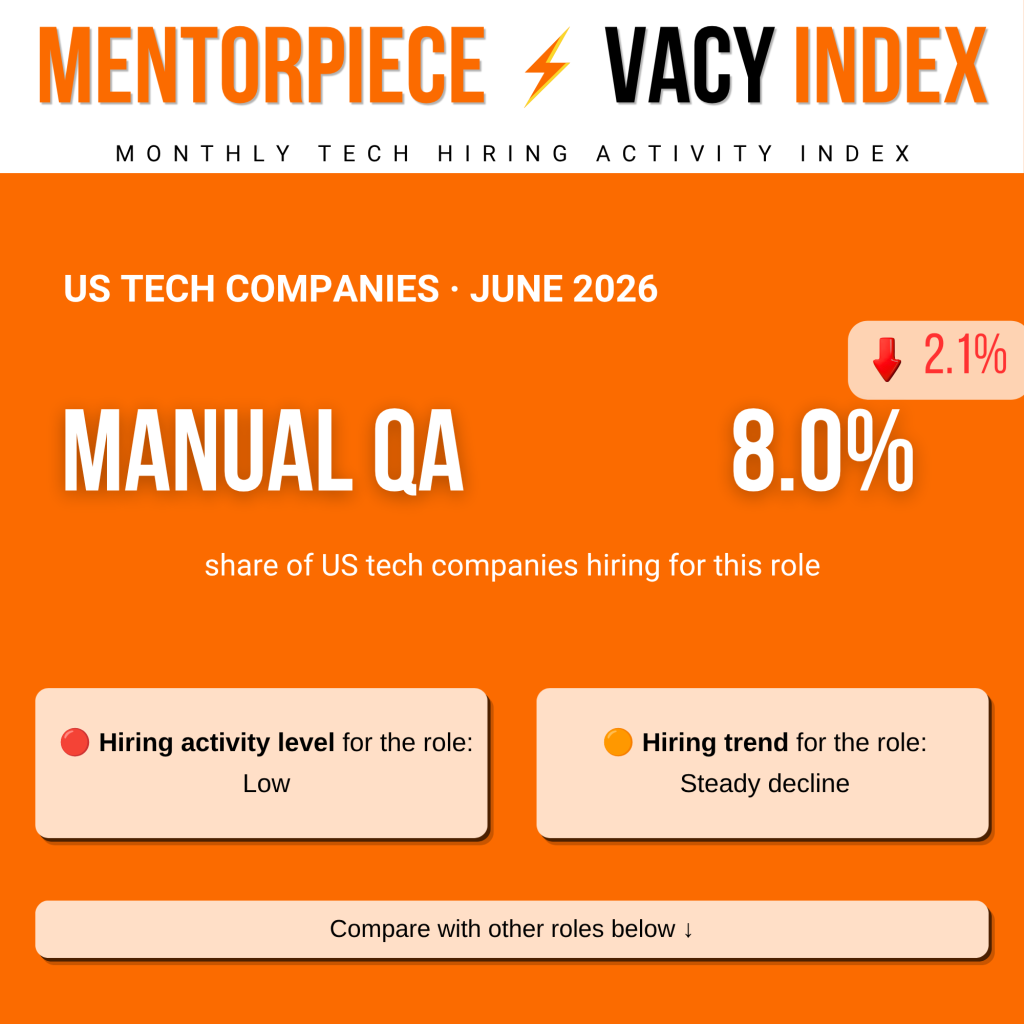
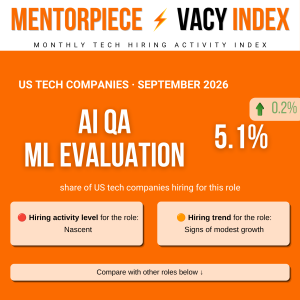
The job market for manual QA engineers is steadily declining—the downturn has been going on for months now.
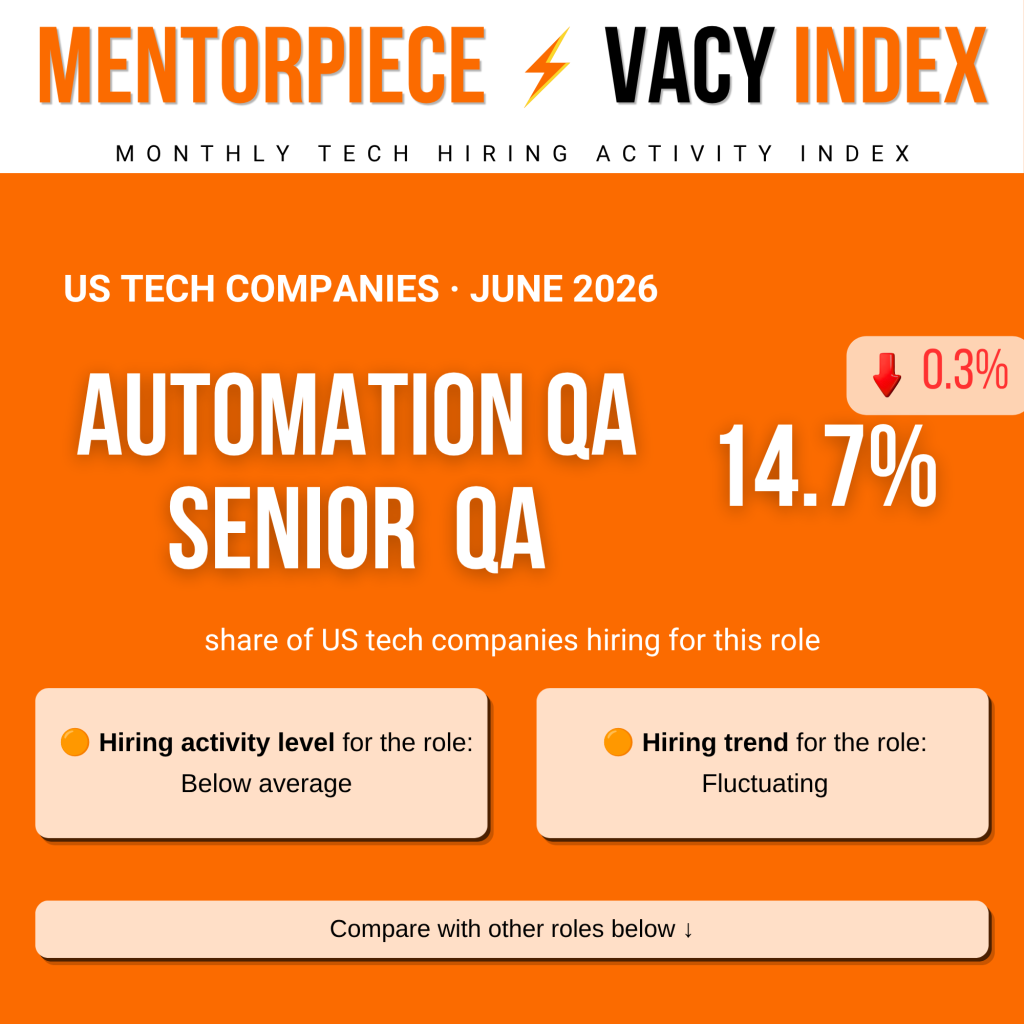
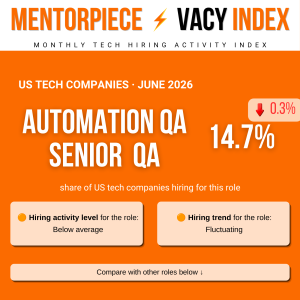
There have been no significant changes in the job market for automation engineers and senior QA specialists in recent months; we will continue to monitor how these trends develop.
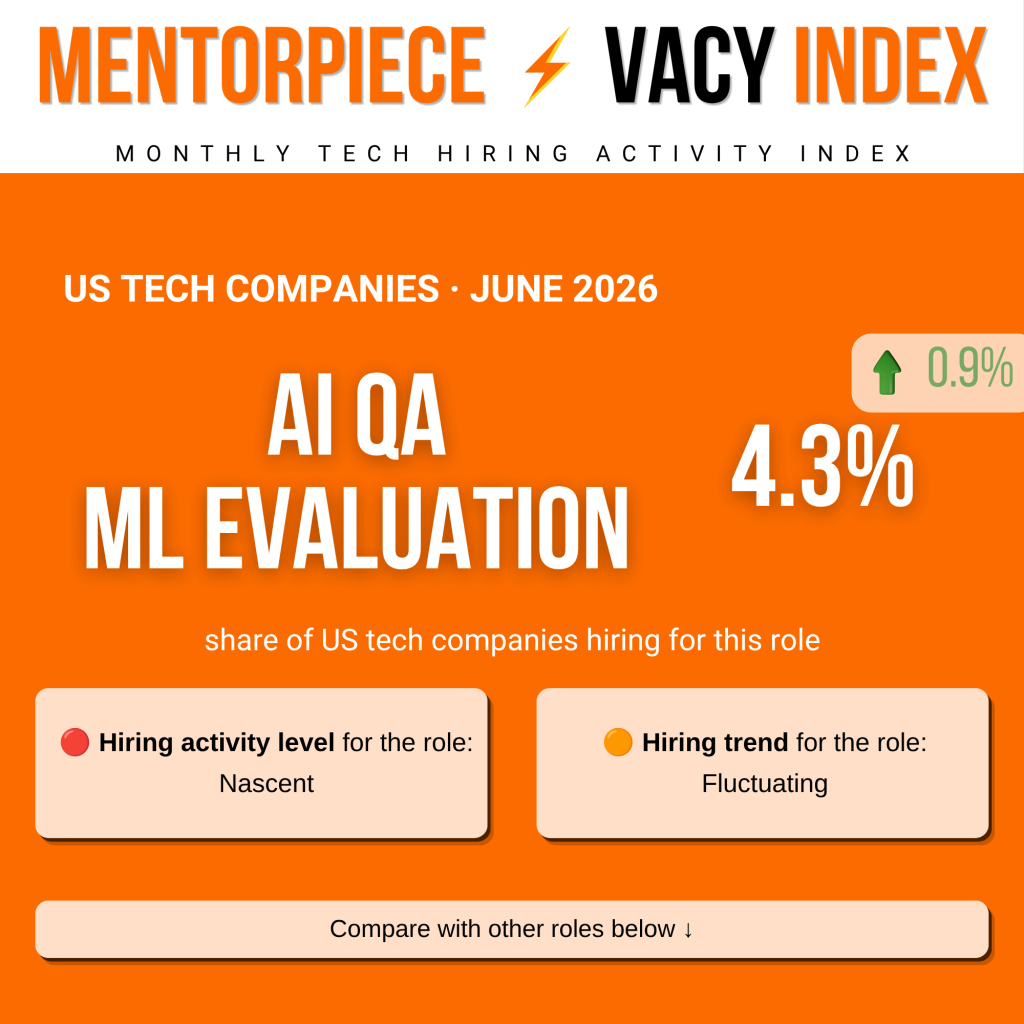
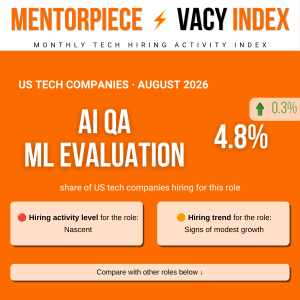
Two months ago, the gap in open positions between traditional manual QA engineers and AI application QA engineers stood at 3:1; now, it has narrowed to 2:1.
The AI application testing market is still in its infancy and growth is modest—but we are tracking how it evolves.
Most interestingly, we are witnessing the emergence of AI application development as a distinct segment. While it currently represents a small share of overall hiring, we are keeping a close eye on its trajectory.
What are the benefits of a hiring activity index?
The app is based on a fixed sample—a consistent cohort of tech companies. By aggregating data on hiring activity within this specific group, we can track the state of the tech job market on a weekly, monthly, and annual basis.
When developing the Mentorpiece Vacy Index, we prioritized several key methodological factors:
A fixed, yet dynamic, company cohort
We monitor the same tech companies every day—otherwise, it would be unclear what we’re comparing month to month. But to ensure the cohort remains relevant and doesn’t become outdated, we use a cumulative approach: every month, our AI agents automatically add a set number of new tech companies to the sample.
A few statistical details
The cohort size increases monotonically as new companies are added—once a company posts a tech job opening, it remains in the monitoring system for all subsequent periods.
However, we deliberately deviate from the rule of monotonically increasing data volume if we discover that a particular employer has actually posted or is posting fraudulent job listings. In such cases, we remove that employer from the cohort retroactively, stripping them from all previous periods as well. That said, this happens rarely and does not significantly affect the sample size.
Approximately 100 companies are added to the survey each month. It is important to note that these additions are exclusively companies that posted new tech openings within that specific month. As a result, the index readings are slightly skewed upward—the percentage of companies with open tech job openings appears higher than the true market baseline. However, since the number of companies included in the monitoring is constantly increasing, this margin of error decreases proportionally each month.
Working with primary sources
Why “stale” job openings appear:
Job postings on platforms like LinkedIn often follow a long syndication chain: Company → ATS → Dice → LinkedIn Jobs. As a result, search results frequently include listings that were filled long ago.
That’s why Mentorpiece Vacy Index AI agents visit not only LinkedIn but also the primary career pages of every monitored company on a daily basis to verify the actual status of each listing.
Sometimes, companies neglect to remove closed job postings from their own websites. As a hiring activity index, Mentorpiece Vacy Index can’t do anything about this.
But as a job-monitoring tool, it can
The app shows the date each job posting was made public—even if it was posted on the company’s website, where publication dates aren’t displayed at all. And if a job posting was published half a year ago, that’s a reason to question its relevance.
Working with primary sources—such as company websites—often allows Mentorpiece Vacy Index to be the first to learn about job openings and respond more quickly to market conditions. While an accounting department processes the invoice for a job site, HR can already post the opening on the company’s own website.
In addition, working directly with these primary sources allows us to filter out scammers more effectively.
Fraudsters aren’t included in the statistics
Working with a consistent group of employers and using websites as primary sources makes it easier to identify scammers.
When tracking the metric “how many job openings are currently available,” it’s difficult to constantly verify that every job posting is from a real company as tens of thousands of openings appear and disappear every month.
But since we work with a more compact, fixed list of employers, it is much easier to perform such checks.
Each role is monitored separately
AI agents analyze each QA job opening they find, categorizing them into the following roles: Manual QA, QA Middle; AQA, Senior; AI-QA, ML Evaluation.
If you’re working with a traditional tech stack, the growing demand for AI development won’t be of much help to you. And vice versa.
Due to the aforementioned filtering issues on job boards, it’s impossible to distinguish between different skill levels. Consequently, the “number of open positions” metric doesn’t accurately reflect the current demand for your specific role.
Mentorpiece Vacy Index calculates the percentage of tech companies with open job postings for each role separately.
Why are only QA and AI/ML Evaluation job postings tracked?
There are three simple reasons:
- QA Engineer and ML Evaluation job openings are less tied to specific programming languages and therefore provide a more consistent picture of the market.
- These roles are just as likely to be cut as the developer role—it might seem that writing new code is more valuable than finding bugs, but developers are also significantly more expensive. Based on my experience, companies tend to downsize entire teams rather than specific roles.
- I worked as a QA engineer from 2001 to 2024, and since 2024, I have been an ML evaluation engineer; these are the roles I identify with most.
However, if there is sufficient interest, we may add some other roles as well.
What the Mentorpiece Vacy Index CAN’T handle
It cannot detect ghost jobs that companies publish to maintain their image for customers, partners, and competitors. Investors actively monitor hiring trends at companies in a given sector, and sometimes this forces companies to “put on a brave face” when things are actually going poorly. A company may already be on the verge of bankruptcy, yet job postings remain active to signal that “everything is fine.”
It’s also important to understand that the metric “what percentage of tech companies currently have job openings” has the following advantages over “how many job openings there are currently”:
- If there is a spike in hiring at startups, but the number of openings at large companies decreases, the Mentorpiece Vacy Index adjusts proportionally.
but it also has the following shortcomings:
- If there were a sudden surge in the number of open positions, but the number of tech companies grew even faster, the Mentorpiece Vacy Index would decrease.
Currently, the biggest shortcoming of our tech hiring activity index is its lack of sensitivity to the size of tech companies (a phenomenon where a single job posting “on display” by a large company often means hiring dozens of specialists, while a single job posting at a startup usually refers to just one person). However, the “number of open positions” metric suffers from the same limitation. As we accumulate more data, we may add a “company size” weighting factor.
More details
- How Mentorpiece Vacy & ⚡️Mentorpiece Vacy Index work.
- A preview of job openings added daily by AI agents to the database used to calculate the index (via Telegram): Manual QA, Automation/Senior QA, and AI QA/ML Evaluation.
What does the future hold for tech hiring?
The ⚡️Mentorpiece Vacy Index, an indicator of tech hiring activity, will be released next month:
- Here, in the Orange QA Journal
- On various social media platforms
I hope that this year, the tech hiring activity indicator will finally show some positive signs.